Personal Loan Rejected? 10 Reasons and How to Get Approved
- 24 Jul 2026
- Kuvik Loans
- Personal Loan
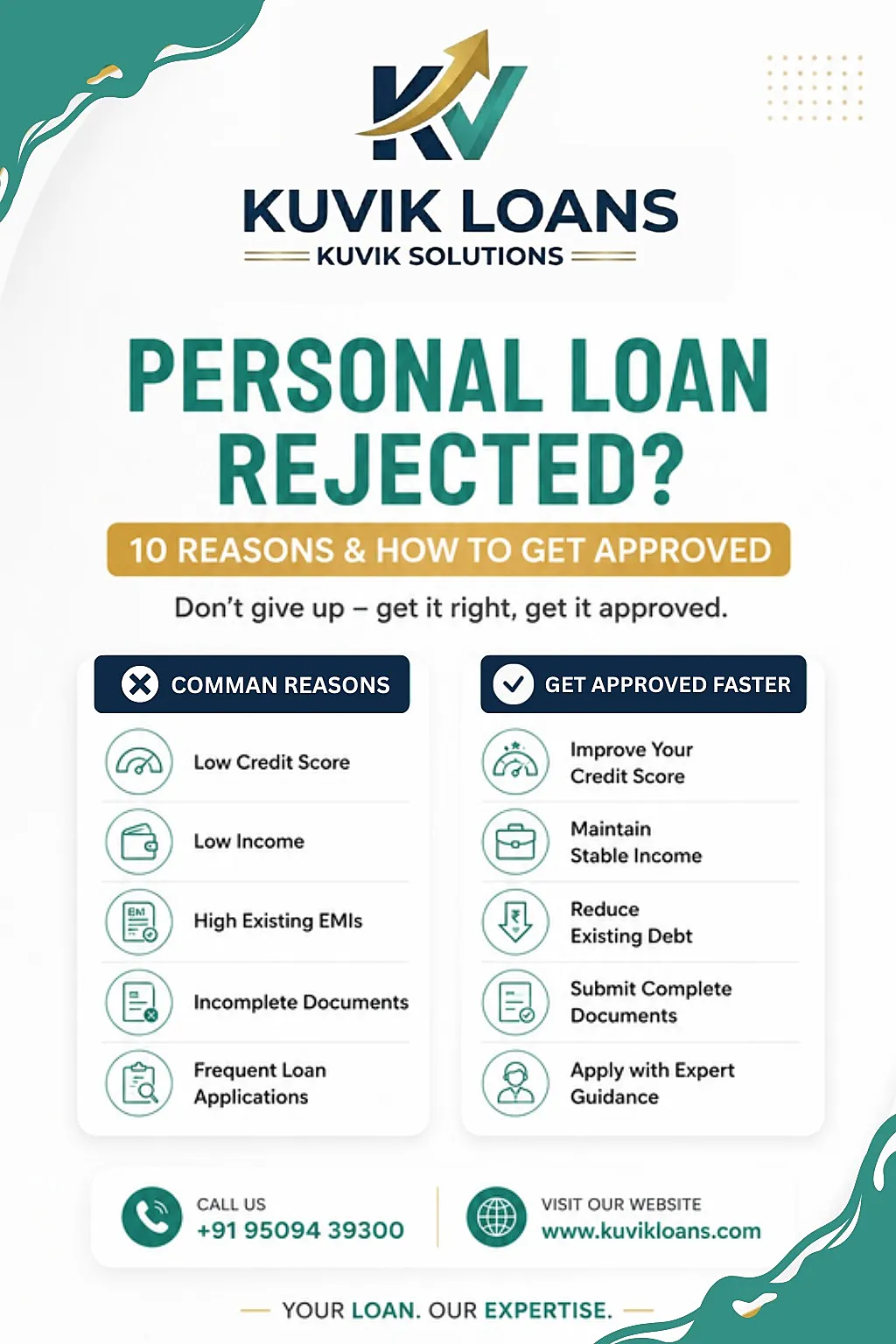
Applying for a personal loan can feel exciting. You may already have a clear plan for the money, whether it's managing a medical emergency, funding a wedding, renovating your home, consolidating debt, or handling an unexpected expense.
Then comes the notification you were hoping not to see:
"Your personal loan application has been rejected."
It can be frustrating, especially when you thought you met the basic eligibility requirements. But a rejected application doesn't necessarily mean you'll never qualify for a personal loan. The first step is understanding why your personal loan was rejected.
Lenders evaluate several aspects of your financial profile before approving an unsecured loan. Since there is no property, gold, or other asset offered as collateral, lenders rely heavily on your income, credit history, repayment capacity, employment stability, and documentation.
In this guide, we'll explain the most common personal loan rejection reasons, answer the question "why personal loan is rejected?", and share practical tips on how to get personal loan approved in the future.
Why Personal Loan Is Rejected: Understanding the Basics
A personal loan is an unsecured loan. This means the lender does not have a physical asset to recover if the borrower fails to repay the loan. Because of this, lenders carefully assess your ability and willingness to repay.
Your application may be rejected if the lender believes that:
- Your income is insufficient for the requested loan amount.
- Your credit history shows missed or delayed payments.
- Your existing EMIs are already too high.
- Your employment or income is unstable.
- Your documents are incomplete or inconsistent.
- You don't meet the lender's age or location requirements.
- You've applied for too many loans recently.
- The lender's internal eligibility criteria aren't met.
The important thing to remember is that rejection is not always permanent. In many cases, you can improve your financial profile and apply again after addressing the underlying issue.
Let's look at the ten most common reasons behind a personal loan application rejected status.
1. Low or Poor CIBIL Score
Your personal loan CIBIL score is one of the most important factors lenders consider. A credit score reflects your past borrowing and repayment behaviour. It helps lenders understand how responsibly you've managed loans and credit cards in the past. If you've missed EMI payments, delayed credit card payments, defaulted on loans, or settled previous debts, these events may negatively affect your credit profile.
A low CIBIL score can make lenders cautious because it may indicate a higher risk of repayment problems.
What can you do?
If your personal loan was rejected because of your credit score, focus on rebuilding your credit profile before applying again.
To improve CIBIL score for loan applications:
- Pay all EMIs and credit card bills on time.
- Keep credit card utilisation under control.
- Avoid applying for multiple loans within a short period.
- Review your credit report regularly.
- Dispute inaccurate information on your credit report.
- Maintain older credit accounts responsibly.
- Avoid closing your oldest credit accounts unnecessarily.
Improving your CIBIL score takes time, so don't expect an overnight change. Consistent financial discipline is the key.
2. Insufficient Income or Low Repayment Capacity
Another common reason for personal loan rejection is insufficient income compared to the requested loan amount. For example, if you earn ₹50,000 per month but apply for a loan amount that results in an extremely high EMI, the lender may determine that repayment could put excessive pressure on your finances.
Lenders generally want to ensure that after paying your loan EMI, you still have enough income for regular household expenses and other financial commitments.
Your income may be considered insufficient because:
- Your salary is below the lender's minimum requirement.
- You are applying for a loan amount that is too high.
- Your existing EMIs already consume a significant part of your income.
- Your income is irregular or difficult to verify.
How can you improve your chances?
Consider applying for a lower loan amount or choosing a longer repayment tenure to reduce your monthly EMI. Before applying, use a personal loan EMI calculator to estimate how much you can comfortably repay every month. The goal isn't simply to borrow the maximum amount available. The right loan is one that fits comfortably within your monthly budget.
3. High Existing Debt and Multiple EMIs
Already paying a home loan, car loan, education loan, or another personal loan? That's not automatically a problem. However, lenders will consider all your existing financial obligations when assessing your application. If a large portion of your monthly income is already committed towards EMIs, the lender may conclude that you have limited capacity to take on additional debt.
For example, someone earning ₹80,000 per month with existing EMIs of ₹50,000 may have less repayment capacity than someone earning ₹60,000 with existing EMIs of ₹10,000.
What can you do?
Before applying again:
- Pay off smaller loans if financially possible.
- Reduce outstanding credit card balances.
- Avoid taking on unnecessary new debt.
- Consider whether you really need the maximum loan amount requested.
Reducing your existing financial obligations can improve your personal loan eligibility and make your application more attractive to lenders.
4. Unstable Employment or Irregular Income
Lenders prefer borrowers with a predictable source of income. If you've recently changed jobs, have frequent employment gaps, or receive irregular income, your application may require additional assessment.
For salaried applicants, lenders may consider:
- Length of employment with the current organisation.
- Total work experience.
- Employer profile.
- Regularity of salary credits.
- Stability of monthly income.
Self-employed applicants may be assessed based on business continuity, income consistency, tax returns, and financial statements. A recent job change doesn't automatically mean your loan will be rejected. However, if your income history appears unstable, the lender may view the application as higher risk.
How can you improve your chances?
Maintain a stable employment and income history. Keep your salary account active and ensure that salary credits are clearly visible in your bank statements. If you're self-employed, maintain proper financial records and file your Income Tax Returns regularly.
5. Errors or Missing Personal Loan Documents
Sometimes, the reason for a rejected application is not your income or credit score; it could simply be incomplete documentation. Your personal loan documents help the lender verify the information you've provided in your application.
Common documents may include:
- PAN Card
- Aadhaar Card or other identity proof
- Address proof
- Recent salary slips
- Bank statements
- Form 16, where applicable
- Employment proof
If the documents are unclear, expired, incomplete, or inconsistent, the lender may be unable to complete the verification process. For example, differences in your name across documents, an outdated address, or bank statements that don't clearly show salary credits may trigger additional verification.
What should you do?
Before applying again:
- Check that all documents are valid.
- Ensure your personal information is consistent.
- Upload clear, readable copies.
- Provide the latest salary slips and bank statements.
- Keep additional income proof ready if required.
A well-prepared application can significantly improve the efficiency of the verification process.
6. Too Many Recent Loan Applications
Every time you apply for credit, the lender may conduct a hard enquiry on your credit report. Applying for multiple loans or credit cards within a short period can create the impression that you're actively seeking credit from several sources. From a lender's perspective, this may indicate financial stress or an urgent need for funds.
This doesn't mean you should never compare loan offers. However, repeatedly submitting applications to multiple lenders without understanding your eligibility can work against you.
How can you avoid this?
Before applying:
- Check your eligibility.
- Compare loan options carefully.
- Avoid submitting multiple applications simultaneously.
- Understand the lender's basic criteria.
If your application has recently been rejected, waiting for some time before applying again may be sensible, especially if multiple recent credit enquiries appear on your report.
7. Applying for the Wrong Loan Amount or Tenure
Sometimes, the problem isn't that you're ineligible for a personal loan. You may simply be applying for an amount that doesn't match your financial profile. For example, you may qualify for a ₹5 lakh loan but apply for ₹15 lakh. Similarly, a short repayment tenure may result in an EMI that is too high for your monthly income.
How can you improve your application?
Choose a loan amount based on your actual requirement and repayment capacity. A longer tenure can reduce the monthly EMI, although it may increase the total interest paid over the life of the loan. A shorter tenure may help reduce the overall interest cost but will result in higher monthly EMIs. The right balance depends on your income, existing commitments, and financial goals.
8. Inaccurate Information in Your Application
Providing incorrect information, whether intentionally or accidentally, can create problems during verification.
For example:
- Your stated salary doesn't match your salary slips.
- Your employer details are incorrect.
- Your residential address differs across documents.
- Your bank statements don't reflect the income mentioned.
- Your employment details cannot be verified.
These inconsistencies may lead to a rejected application.
The solution is simple:
Always provide accurate and complete information.
Before submitting your application, carefully review:
- Your personal details.
- Employer information.
- Monthly income.
- Existing loan obligations.
- Contact details.
- Residential address.
A few extra minutes spent checking your application can help prevent avoidable errors.
9. Not Meeting the Lender's Eligibility Criteria
Every lender has its own internal eligibility criteria.
Even if you meet the basic requirements for a personal loan, you may not meet the specific criteria of a particular lender.
These requirements may include:
- Minimum age.
- Maximum age at loan maturity.
- Minimum monthly income.
- Minimum employment tenure.
- Location or city requirements.
- Employer category.
- Credit score requirements.
This is why rejection by one lender doesn't necessarily mean you are ineligible for all personal loans. Your financial profile may be suitable for another lender with different eligibility criteria.
What can you do?
Instead of repeatedly applying randomly, compare loan options based on your profile. A platform like Kuvik Loans can help eligible borrowers explore suitable lending options and understand the loan products that may better match their financial situation.
10. Your Credit Report Contains Errors
Sometimes, your application may be rejected because of information on your credit report that is incorrect.
For example, your credit report may show:
- A loan you never took.
- An EMI marked as unpaid despite being paid.
- An account that should have been closed.
- Incorrect personal information.
- Duplicate loan accounts.
These errors can negatively affect your credit profile.
What should you do?
Obtain a copy of your credit report and review it carefully. If you find inaccurate information, raise a dispute with the relevant credit bureau or financial institution. Once incorrect information is corrected, your credit profile may improve. However, updates can take time, so it's important to plan accordingly before applying again.
How to Get a Personal Loan Approved After Rejection
If your personal loan application has been rejected, don't immediately submit another application. Instead, take a step back and understand what went wrong.
Here are some practical personal loan approval tips.
· Find out the reason for rejection - The first step is understanding the reason behind the rejection. Review any communication from the lender and check your credit report if necessary. Without identifying the problem, applying again may simply lead to another rejection.
· Improve your CIBIL score - If your credit score is the issue, focus on building a stronger repayment history. Pay bills on time, reduce outstanding balances, and avoid multiple new credit applications. Over time, these habits can help improve CIBIL score for loan applications.
· Reduce your existing debt - Paying off smaller loans or reducing credit card balances can improve your repayment capacity. This may also increase the loan amount you can comfortably qualify for.
· Apply for a realistic loan amount - Don't apply for more than you need or more than you can comfortably repay. A lower loan amount with an affordable EMI may improve your chances of approval.
· Prepare your personal loan documents - Keep all your documents ready before applying. Your application should include accurate, recent, and clearly readable documents that support your identity, income, and employment details.
· Avoid multiple applications - Don't apply to several lenders at the same time. Instead, compare your options carefully and apply to lenders whose eligibility criteria match your profile.
· Consider a co-applicant where appropriate - Depending on lender policies, applying with an eligible co-applicant may improve overall repayment capacity. However, both applicants should understand that they may share responsibility for repaying the loan.
Can You Apply Again After a Personal Loan Rejection?
Yes, you can generally apply again after your personal loan application has been rejected. However, the timing depends on the reason for rejection. If your application was rejected because of a missing document, you may be able to address the issue relatively quickly. If the reason was a low credit score or high debt burden, it may be better to spend time improving your financial profile first.
Applying again without making any changes may result in another rejection.
How Kuvik Loans Can Help
Finding the right personal loan shouldn't involve repeatedly applying and hoping for approval. At Kuvik Loans, we help simplify the borrowing journey by helping customers explore loan options based on their financial profile and requirements. Whether you're looking for a personal loan for an emergency, planned expense, debt consolidation, or another financial need, understanding your eligibility before applying can help you make a more informed decision. You can explore suitable loan options, understand the factors lenders consider, and get assistance throughout the application process.
The goal is simple: help you approach borrowing with better information and greater confidence.
A Rejected Personal Loan Doesn't Mean the End
Having your personal loan rejected can be disappointing, but it doesn't necessarily mean you won't qualify in the future. The most important thing is to understand the reason behind the rejection. Whether the issue is a low personal loan CIBIL score, high existing debt, insufficient income, incomplete personal loan documents, too many recent credit applications, or simply not meeting a particular lender's eligibility criteria, most problems can be addressed with the right approach. Before applying again, take time to review your financial profile, improve your repayment capacity, organise your documents, and choose a loan amount that fits comfortably within your budget.
If you're wondering how to get a personal loan approved, the answer starts with preparation. At Kuvik Loans, we help make the loan search process simpler by helping you explore suitable lending options and understand your borrowing possibilities.
Don't let one rejection stop you from moving forward. Check your eligibility, understand your options, and take your next step towards personal loan approval with Kuvik Loans.
Frequently Asked Questions
1. Why is my personal loan rejected?
A personal loan may be rejected due to a low CIBIL score, insufficient income, high existing EMIs, unstable employment, incomplete personal loan documents, too many recent credit enquiries, or not meeting the lender's eligibility criteria.
2. What are the most common personal loan rejection reasons?
Common personal loan rejection reasons include a poor credit history, high debt-to-income ratio, low or irregular income, frequent job changes, inaccurate application details, incomplete documents, and applying for a loan amount that exceeds your repayment capacity.
3. How can I improve my chances of personal loan approval?
To improve your chances of personal loan approval, maintain a healthy CIBIL score, pay existing EMIs on time, reduce outstanding debt, choose a realistic loan amount, provide accurate information, and submit all required personal loan documents.
4. How can I improve my CIBIL score for a personal loan?
To improve your CIBIL score for a loan, pay your EMIs and credit card bills on time, maintain low credit utilisation, avoid multiple loan applications, review your credit report regularly, and dispute any incorrect information.
5. Can I apply for a personal loan again after my application is rejected?
Yes, you can apply again. However, it's advisable to first understand why your personal loan was rejected and address the underlying issue before reapplying. Applying again without making any changes may result in another rejection.
6. What personal loan documents are required for approval?
Common personal loan documents include identity proof, address proof, PAN Card, Aadhaar Card, salary slips, bank statements, and employment proof. The exact documents required may vary depending on the lender and your financial profile.
7. How long should I wait before applying for a personal loan again?
There is no fixed waiting period applicable in every situation. If the rejection was due to missing documents or incorrect information, you may be able to reapply after correcting the issue. However, if the reason was a low CIBIL score or high debt, it's better to improve your financial profile before applying again.
