Business Loan Documents: Know Complete Checklist for Entrepreneurs
- 15 Oct 2026
- Kuvik Loans
- Business Loan
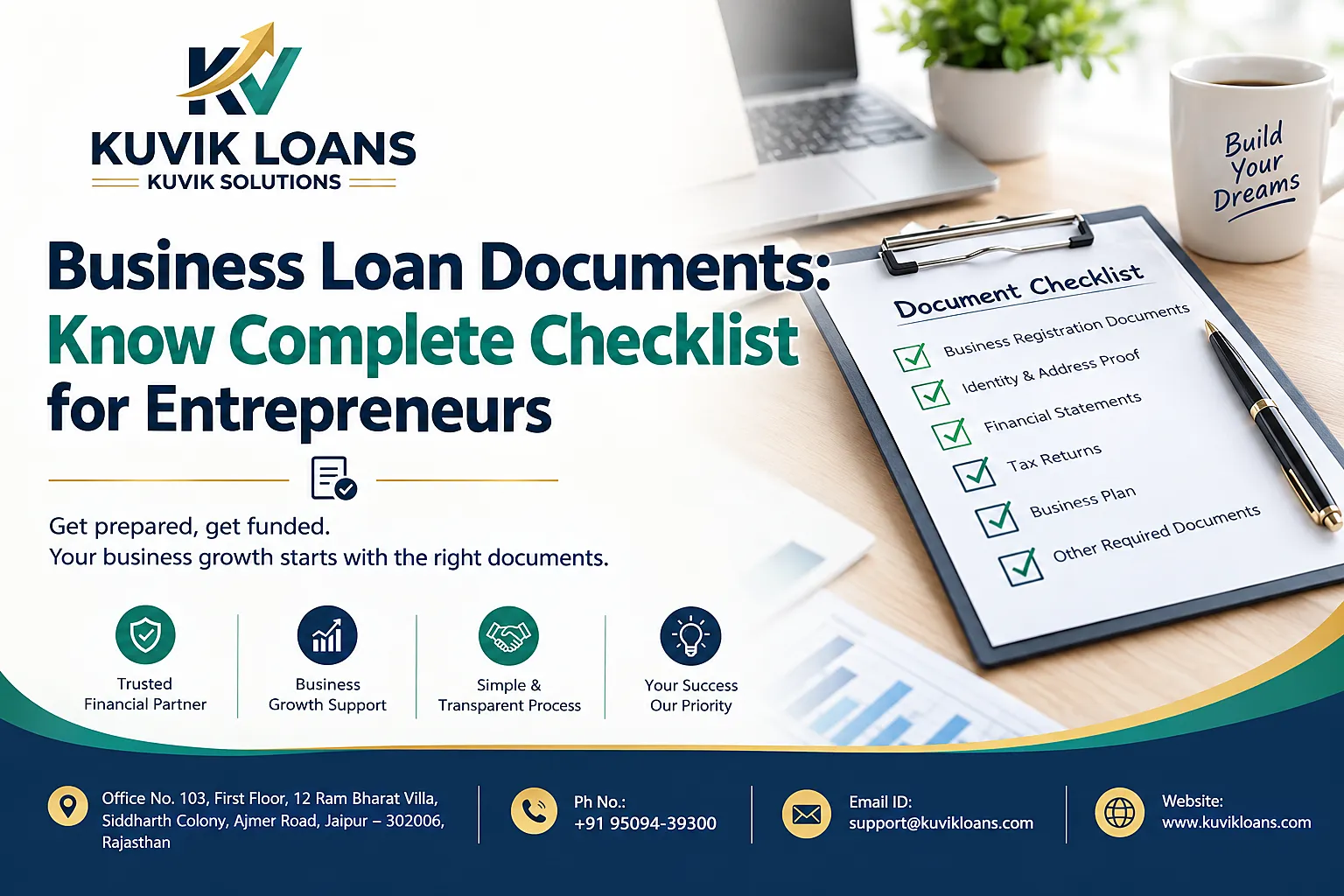
Applying for a business loan is easier when your financial and business records are ready. Lenders need documents to verify your identity, business activity, income, turnover, credit profile, and repayment capacity.
The exact business loan documents required can vary by lender, loan type, business structure, and applicant profile. A sole proprietor may need a different set of documents than a private limited company or partnership firm.
This complete checklist explains the common documents you may need, why lenders ask for them, and how to prepare before applying for a business loan.
Why are Business Loan Documents Important?
A lender needs to understand your business before approving financing.
Your documents can help establish:
- Who owns and operates the business
- How long the business has been operating
- How much revenue it generates
- Whether it is profitable
- How money moves through the business
- Whether existing debt is being managed properly
- Whether the proposed loan may be affordable
For example, your bank statements can show business transactions, while ITRs and financial statements can provide information about reported income and expenses.
Together, these records help create a clearer picture of your financial position.
Complete Business Loan Documents Checklist
The following checklist covers the most common categories of documents.
1. Identity and KYC Documents
Identity verification is one of the first parts of a loan application.
Common KYC documents may include:
- PAN card
- Aadhaar card
- Passport
- Voter ID
- Driving licence
- Other officially accepted identity documents
Business owners, directors, partners, or authorised representatives may need to provide KYC documents depending on the business structure and lender's requirements.
The name and other details should be consistent across the documents wherever applicable.
2. Address Proof
Lenders may require proof of residential and/or business address.
Common documents may include:
- Aadhaar
- Passport
- Utility bill
- Rental agreement
- Property-related documents
- Other accepted address proof
The required proof may depend on whether the lender needs the applicant's residential address, registered business address, operating address, or all of these.
3. Business Registration Documents
Lenders may need evidence that your business is legally established and operating.
The documents can vary based on the type of business.
For example:
Sole Proprietorship
You may need documents that establish the proprietor's identity and business activity.
Partnership Firm
Common documents may include:
- Partnership deed
- Registration documents, where applicable
- KYC of partners
- Business proof
Private Limited Company
Documents may include:
- Certificate of Incorporation
- Memorandum of Association
- Articles of Association
- Company PAN
- Director KYC documents
- Other corporate records, where applicable
LLP
An LLP may need:
- LLP incorporation documents
- LLP agreement
- PAN
- KYC of designated partners
- Other applicable business records
The exact documentation depends on the lender and legal structure of the business.
4. Income and Financial Documents
Financial documents help lenders understand the business's revenue, expenses, profitability, and overall financial position.
Common business loan documents in this category include:
- Income Tax Returns
- Profit and Loss statements
- Balance sheets
- Cash-flow statements, where applicable
- Audited financial statements, where applicable
The lender may request financial records for specific financial years.
Why are Financial Statements Important?
Consider a business with annual sales of ₹80 lakh.
Sales alone do not show how much the business earns after expenses.
For example:
|
Particulars |
Illustrative Amount |
|
Annual turnover |
₹80 lakh |
|
Business expenses |
₹68 lakh |
|
Approx. surplus |
₹12 lakh |
This is why lenders may look at both revenue and profitability when assessing repayment capacity.
5. GST and Tax Documents
For businesses registered under GST, GST-related records can provide information about business activity and reported turnover.
Depending on the application, lenders may ask for:
- GST registration certificate
- GST returns
- GST-related statements
- Income Tax Returns
- Other applicable tax records
Keeping tax filings updated can help maintain consistent financial records.
If the turnover reported in different documents varies significantly, the lender may seek clarification or additional supporting information.
6. Bank Statements
Business bank statements are another important part of the documentation process.
A lender may review them to understand:
- Regular business receipts
- Supplier payments
- Operating expenses
- Existing EMI payments
- Cash-flow patterns
- Banking behaviour
The lender may request statements for a particular period, such as the previous few months.
It is important to provide statements from the account requested by the lender and ensure they are complete and readable.
7. Documents Based on Business Structure
Your required business loan documents can depend heavily on how your business is organised.
|
Business Type |
Possible Documents |
|
Sole Proprietorship |
Proprietor KYC, business proof, tax and financial records |
|
Partnership |
Partnership deed, partner KYC, business and financial records |
|
LLP |
LLP agreement, incorporation documents, partner KYC |
|
Private Limited Company |
Incorporation certificate, MOA, AOA, director KYC, financial records |
|
Other entities |
Applicable registration, ownership and financial documents |
This is only a general guide. The lender may request additional documents depending on the loan and applicant.
8. Additional Documents Lenders May Ask For
Depending on your business and loan requirement, additional documents may include:
Proof of Business Address
This may include a rent agreement, utility bill, or other accepted document.
Existing Loan Statements
If you already have loans, the lender may ask for current loan statements and repayment details.
Ownership Documents
For certain businesses or secured financing, ownership or property-related documents may be required.
Business Licences
Some industries require specific licences or registrations to operate.
Purchase Orders or Invoices
For certain business financing requirements, lenders may ask for documents that support the purpose of borrowing.
Project or Business Plan
For larger or specialised financing requirements, a lender may request a business plan, project report, projected cash flows, or other supporting information.
How to Prepare Your Business Loan Documents
Preparing your documents before applying can save time and reduce back-and-forth during the application process.
Step 1: Create a Document Folder
Keep digital copies of your KYC, business registration, tax, financial, and banking records in one secure location.
Step 2: Check Expiry and Validity
Make sure documents such as licences and registrations are current wherever applicable.
Step 3: Check Names and Details
Look for inconsistencies in names, addresses, PAN details, business names, and other important information.
Step 4: Organise Financial Records
Keep ITRs, GST returns, bank statements, P&L statements, and balance sheets organised by financial year.
Step 5: Keep Recent Bank Statements Ready
Use complete statements covering the period requested by the lender.
Step 6: Prepare Existing Loan Details
Keep current loan statements and repayment information available if you already have business or personal credit obligations.
Business Loan Application Process
Once your documentation is ready, the application process may generally involve these steps:
ü Identify Your Funding Requirement - Decide why you need the loan and estimate the amount required.
ü Check Eligibility - Review requirements related to business vintage, turnover, income, credit profile, and documentation.
ü Compare Loan Options - Compare interest rates, loan amounts, tenure, fees, repayment terms, and other applicable conditions.
ü Submit Your Application - Provide your personal, business, financial, and tax information.
ü Submit Supporting Documents - Upload or provide the required business loan documents.
ü Complete Verification - The lender may verify your business information, financial records, banking history, and credit profile.
ü Review the Loan Offer - If approved, review the sanctioned amount, interest rate, EMI, fees, tenure, and other terms before accepting the loan.
How Kuvik Loans Can Help?
Kuvik Loans helps entrepreneurs and businesses explore financing options from multiple lenders based on their business requirements and financial profile.
Kuvik offers business loan options of up to ₹50 lakh, with tenure options of 12 to 60 months, subject to lender policies, applicant eligibility, documentation, financial assessment, and applicable terms.
Business loan applications may consider documents and information such as:
- GST turnover
- ITRs
- Bank statements
- Business details
- Credit profile
- Existing liabilities
- Repayment capacity
If you are planning to apply for business financing, having your business loan documents organised can make it easier to understand your financial position and complete the application process.
Final Thoughts
Having the right business loan documents is an important part of preparing for a business loan application. While the exact checklist varies by lender, entrepreneurs should generally be prepared with KYC documents, business registration proof, GST and tax records, ITRs, financial statements, bank statements, and information about existing liabilities.
Good documentation does not guarantee loan approval. However, complete and accurate records can help lenders assess your business more efficiently. Before applying, organise your documents, check your eligibility, calculate your funding requirement, and compare loan terms carefully.
Frequently Asked Questions
1. What are the main business loan documents required?
Common documents include PAN, KYC and address proof, business registration documents, GST records, ITRs, bank statements, financial statements, and existing loan details.
2. Are GST returns required for a business loan?
GST documents may be required for GST-registered businesses. The exact requirement depends on the lender, loan product, and applicant profile.
3. Do I need ITRs to apply for a business loan?
Many lenders may ask for ITRs or other income and financial records to assess business income and repayment capacity. Requirements vary by lender.
4. How many months of bank statements are required?
The required period varies between lenders and loan products. The lender will generally specify the statement period required during the application.
5. Are business registration documents necessary?
Depending on the business structure, lenders may require documents that establish the legal identity and operation of the business.
6. Do existing loan statements need to be submitted?
A lender may ask for details or statements of existing loans to understand your current financial obligations and repayment commitments.
7. Can I apply for a business loan without GST registration?
It depends on the business, loan product, and lender. GST registration may not apply to every business, so alternative business and financial records may be considered where applicable.
8. What documents are required for a sole proprietorship business loan?
A sole proprietor may need personal KYC, business proof, tax records, bank statements, and financial documents. Exact requirements vary by lender.
9. Can incorrect documents delay a business loan application?
Yes. Missing, unclear, outdated, or inconsistent information may result in additional verification or delays.
10. How can I prepare my business loan documents?
Create a checklist covering KYC, business registration, GST, ITRs, financial statements, bank statements, and existing loan details. Keep digital copies organised and ensure the information is accurate and current.
